
The Weight of Becoming: What Strength Passes Down
A review of Gideon Adeyeye’s poetry collection
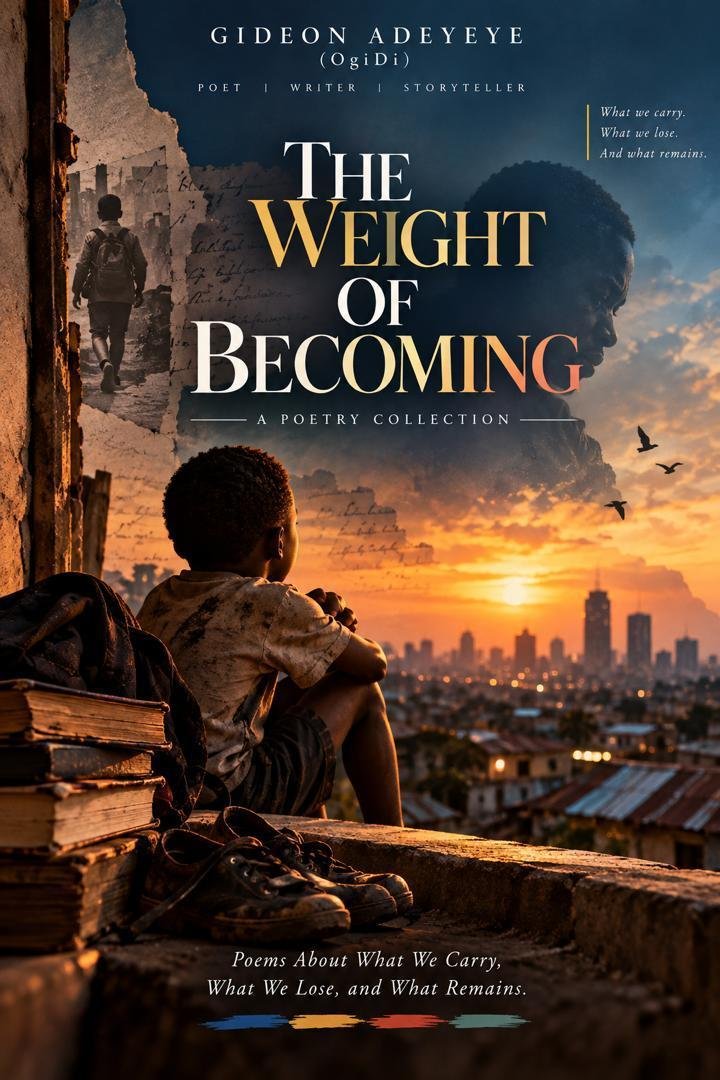
A boy runs to his father after his brother comes home bleeding. He expects intervention. Instead, his father asks what he intends to do about it.
In First Child, the opening poem of Gideon Adeyeye’s The Weight of Becoming, this becomes a lesson in responsibility:
“I wanted rescue.
First Child
He wanted to raise one.”
The distinction is memorable, but also unsettling. The boy receives his father’s approval as an inheritance. What accompanies it is the obligation to carry weight before anyone else feels it. The poem celebrates this as a calling, although its own language describes a departure from childhood.
This is the collection’s most interesting inheritance: love transmitted alongside the expectation of strength. Adeyeye honours the people who keep a family standing, while gradually exposing what standing costs them.
Read against the opening, The Things Men Bury becomes more than a general appeal for men to express their feelings. It questions the training that produces the person everyone calls when something breaks. What happens when that person is also breaking? The speaker admits to some of the evasions he describes, including retreating into darkness because it asks fewer questions. He is implicated in the argument rather than simply delivering it.
The poem eventually imagines a man who can admit uncertainty, seek help and make it safe for others to speak. That places pressure on the opening celebration. The child was praised for becoming a rescuer; the adult must learn that needing rescue does not disqualify him. The collection does not entirely settle the relationship between those positions, and that tension gives it substance.
Poverty makes this inheritance materially urgent. In Two Naira, a rent confrontation leaves a father wounded and a child determined to change the family’s circumstances. Years later, the son places house and car keys into the hands he once watched bleed. The reversal is powerful because the objects answer a particular humiliation.
The poem becomes less convincing when it turns that reversal into a general account of success. Its contrast between the boy who works and others who complain makes deprivation too easy to read as a failure of character. Then comes the claim that the deepest wounds produce the greatest strength. The violence has been given credit for the life built after it.
That claim sits uneasily beside the closing poem’s explicit refusal to call every wound a blessing. These are different accounts of survival. One honours the pain for what supposedly emerged from it; the other allows survival to matter without endorsing the injury.
When the Money Came offers a more complicated account of escape. The speaker finally has enough, but checks the balance repeatedly instead of celebrating. His circumstances have changed faster than his habits.
“I had spent years
When the Money Came
doing mathematics
with fear.”
The phrase gives arithmetic an emotional history. Every purchase once required another need to be postponed. Adeyeye makes money meaningful through the things it can protect: education, medicine, a mother’s rest, a meal where nobody pretends not to be hungry. Ambition here is protective. The son wants to become someone the family can call.
But The Last Call introduces a limit that financial progress cannot remove. A father’s ordinary telephone conversation becomes precious only after it can no longer be repeated. Later achievements arrive with the absence of the person who helped make them imaginable. Becoming successful does not guarantee that everyone who carried you will remain to witness it.
This attention to ordinary things gives Adeyeye some of his best material. The checked balance, the keys in a father’s hands and the instinct to reach for a phone carry more weight than declarations about overcoming hardship.
The language is less assured when it strains for effect. In First Child, “expecting a hero to come leading” awkwardly serves the rhyme with “bleeding”. Elsewhere, the pressure comes from explanation rather than rhyme. Two Naira continues beyond its striking reversal into instructions about honouring pain and remembering the lesson. The story becomes smaller as the declarations become larger.
Leftover Weather provides a welcome change of pace. Rain continues dripping from trees after the storm has moved away. Gutters carry off the afternoon’s excess. A barefoot speaker steps around puddles, trying not to break the reflected sky. The poem gives aftermath a physical duration: the event can end while its effects remain.
“Nothing dramatic is happening now.
Leftover Weather
And that is the mercy.”
For a moment, nobody has to convert difficulty into achievement. The world is simply drying out. That stillness offers a necessary counterweight to a collection so occupied with carrying, providing and becoming.
The Weight of Becoming is most compelling where its gratitude permits examination. The people who kept the family standing deserve to be honoured. Their care is worth inheriting. Their silence need not be.

Vic’Adex
Vic’Adex is the literary and cultural identity of Adetimilehin Inioluwa Victor, a Nigerian author and strategist whose work across poetry, essays, performance and cultural projects explores memory, identity, faith, power, heritage and the changing conditions of African life. He is the founder of 60 Seconds Poetry and Open Mic Ogbomoso. Vic’Adex is one voice working across many forms.