
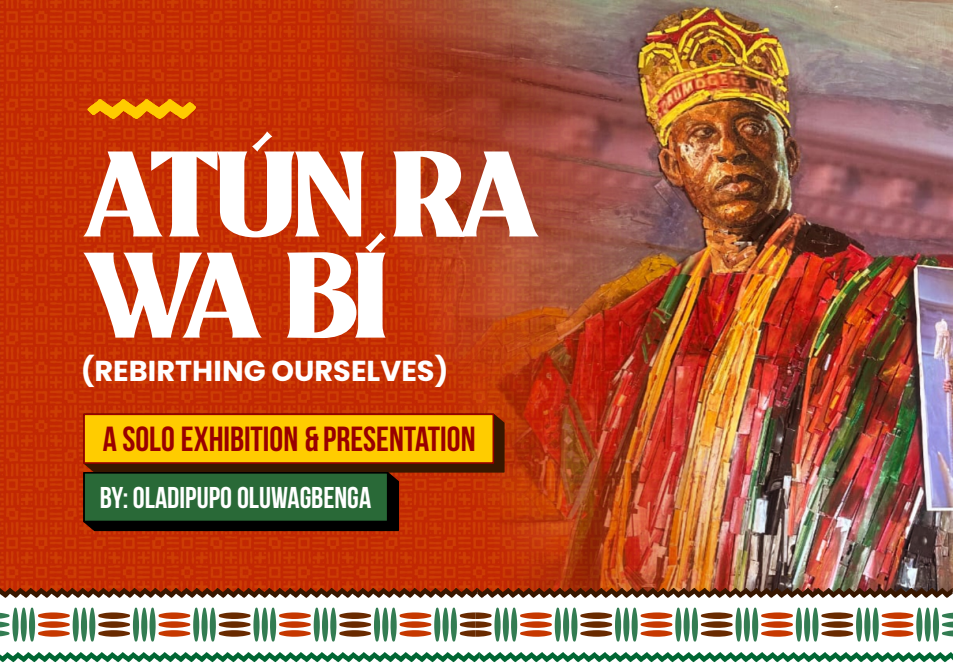
Exhibition appraisal. Originally included in the “Appraisal Highlights” section of the Atun Ra Wa Bi catalogue, page 9, credited to Adetimilehin Inioluwa Victor.
“Iya bi mi, mo tun ra mi bi.”
This aphorism captures a profound Yoruba understanding of rebirth. It speaks to the idea that one can recreate oneself in order to move beyond the limits of present realities. When stagnation meets imagination, metamorphosis becomes not only possible but necessary.
In that light, Atun ra wa bi, the work by Gbenga Oladipupo, embodies this philosophy in material form. Through the use of found and discarded objects, the artist gathers fragments that once served other purposes and reanimates them into a new expression, assembling them piece by piece into the regal likeness of the Soun of Ogbomosho. What was once overlooked or exhausted is given renewed purpose and becomes part of a larger vision.
It brings to mind the words of Rudy Francisco:
“The word repurpose,
It means to take an object and give it amnesia.
It means to make something forget what it’s been trained to do
so you can use it for a better reason.”
In this sense, the work becomes more than representation. It becomes transformation. The materials themselves undergo a quiet rebirth, mirroring the philosophical idea expressed in the proverb.
The piece also resists easy classification. One might call it a painting, a mosaic of recycled material, or even a relief sculpture. Yet none of these definitions fully contain it. The work deliberately inhabits the space between categories, holding fragments of discarded material together until they resolve into a dignified portrait.
The choice of materials is intentional. Plastics have become one of the most persistent pollutants of our time, and their presence here invites reflection on how what we discard may still hold value. In repurposing these materials, the work gestures toward renewal. Just as discarded fragments can be reimagined into something purposeful and dignified, communities too can enter new phases of leadership and possibility.
Atun ra wa bi ultimately chronicles the beginning of a metamorphosis. It marks the dawn of the reign of the new Soun of Ogbomosho, positioning the work as both a portrait and a marker of a historical moment in the life of the city. Through fragments that have been gathered, reimagined, and reborn, the artist constructs a visual metaphor for renewal itself.
Ambitious in both form and meaning, the work stands as a reminder that transformation is always possible. In doing so, it situates itself within the unfolding story of Ogbomosho and its evolving history.