A Review of the Hands Behind the Man Who Made It
Sometimes, it is a family’s prayer
folded into an envelope.
That is a lot for one envelope to carry. In “When Hope Knocked”, a boy has been waiting for admission to the University of Ibadan. Williams puts his parents’ sacrifices, his own sleepless nights and the possibility of a different life inside that letter. The university may have admitted one student. But quite a few people arrived with him.
This is how What Life Left in My Hands opens. The first of its fifteen spoken-word pieces gives us reason to celebrate. The boy has somewhere to go. Then the next poem takes away the people he would have wanted to tell.
“A House Without Roots” first gives us a home held together by two parents. His father strengthens the walls. His mother makes them worth returning to. Sickness moves in like a tenant. Then death starts calling names. One parent goes. Then the other.
an empty chair can occupy
an entire house.
What a terrible reversal of space. The person is gone, but the absence abounds. A chair is supposed to hold somebody; now the fact that it holds nobody seems to fill every room. Williams has already shown the speaker reaching for his phone before remembering there is no one to call. For a moment, habit has allowed him to live in a world where his parents are still available. Then memory catches up.
I keep thinking about the good news in this poem. You become someone your parents would have been proud of, and their absence becomes newly unbearable because they are not there to see it. The future they helped you imagine has come, without them in it.
The danger in “The Snake I Sheltered” is different. Someone is present, close enough to hear the ordinary details of the speaker’s life, but unlike the parent, the architect, as Williams calls him, is a demolition man studying where to pull things down.
I had mistaken my conscience
for a map of everybody else’s.
The poem exposes an unkind and unfair truth. Treating someone well doesn’t guarantee that they will treat us well. The poem makes us confront the entitlement we sometimes believe our goodness has secured us. I wonder how one learns this lesson without making every new acquaintance stand trial for the last person’s offence.
Let us move away from philosophising because, for now, there are bills to pay. “Crowned by the Climb” finds him in the United Kingdom, cleaning hospital rooms to fund his master’s degree.
I worked, then studied.
Studied, then worked.
Even the sentence cannot get a break. Change the order and the same two demands are waiting. His body asks for a rest that his ambition cannot yet afford. I like the image, and I understand the sacrifices required, although I am not entirely on ambition’s side. There is something troubling about celebrating a man’s determination to stop listening to his own body. Still, the exhausted student returns to his books. Eventually, he reaps the rewards of his labour in the rhythm of a distinction. One fruit to stand in for all those nights.
“Fifteen Pounds of Tomorrow” takes us back to the uncertainty behind that achievement. He arrives in Manchester with fifteen pounds and nowhere to sleep. Had he mistaken ambition for preparation? The question sounds different now that we know he succeeded, but there were no guarantees on those frightening first nights.
The frights didn’t restrict themselves to the first few nights.
My script said I had passed.
The result said I had failed.
In “Justice Never Called”, the speaker visits his lecturer to query a failed course. They examine the script together. The answers show a pass. Surely this is where the error gets corrected? Instead, the lecturer says he has never seen him in class. The student remembers going with two classmates to remind this same lecturer to come and teach. He calls them as witnesses. The lecturer still cannot remember. The failure remains.
For someone who once studied in a Nigerian university, this feels harrowing, and Williams makes the absurdity difficult to escape.
My script could speak,
but it could not defend itself.
The paper had no authority. The lecturer has authority and apparently no useful memory. At the end, we are back at the same two statements: the script says pass; the result says fail. Nothing has changed. We have accompanied the student through his appeal and ended up exactly where he started.
In “Homeless Shadows”, the speaker and his wife lose their apartment; she stays with a friend, and he moves into his office. The working day conceals that there is nowhere else for him to go when it ends.
I cannot read that office without remembering the hospital cleaner. Work supported the dream there. Here, work has failed to support even a home. The same advice to persevere would land differently in these two rooms. Williams gives us both, and neither lets us reduce the man to the state of his finances.
The final poem takes us to a child carrying a list of textbooks. His father looks at it and asks for time.
To the child, it is a list. To the father, it is a calculation. Business is struggling. His wife is pregnant. There are other needs. Eventually, he takes money from his savings and gives his son the books’ purchase price.
It was a piece of his peace.
The father has parted with some of the protection his savings gave him, and the child has walked away carrying textbooks. Both have participated in the same exchange, but only one understands its cost. That is the invisible ink: the part of the father’s decision the child was not yet able to understand.
The poem makes me reconsider the admission letter at the beginning. We celebrated the opportunity when it arrived. Now we can see the difficult decisions that helped make such opportunities possible. The book ends by spotlighting someone whose work could so easily have disappeared inside his child’s success. His father is gone by the time the son can fully recognise it.
There is, however, someone he can still help. I return to “Another Man’s Storm”, set at Piccadilly station. A stranger says he travelled for a job interview and lost his bank card and phone. He needs fifteen pounds to get back to Leeds.
Fifteen pounds. We have met that amount before.
Once, it measured what the speaker had left when he did not know where he would sleep. Now it measures the distance between another man and the possibility of getting home. The sum has stayed the same. The person able to do something about it has changed.
The gift changes hands.
Its meaning keeps moving.
Gratitude has found someone other than the original giver. This is also the man who discovered that kindness was no guarantee of kindness in return. He has reasons to distrust people, as well as reasons to recognise their need. Neither experience has been allowed to settle the question of who every stranger must be.
I am glad he does not tell us that the stranded man goes on to achieve something extraordinary. He does not know what happens in Leeds. For once, we are allowed to help someone without requiring his future to vindicate the decision.
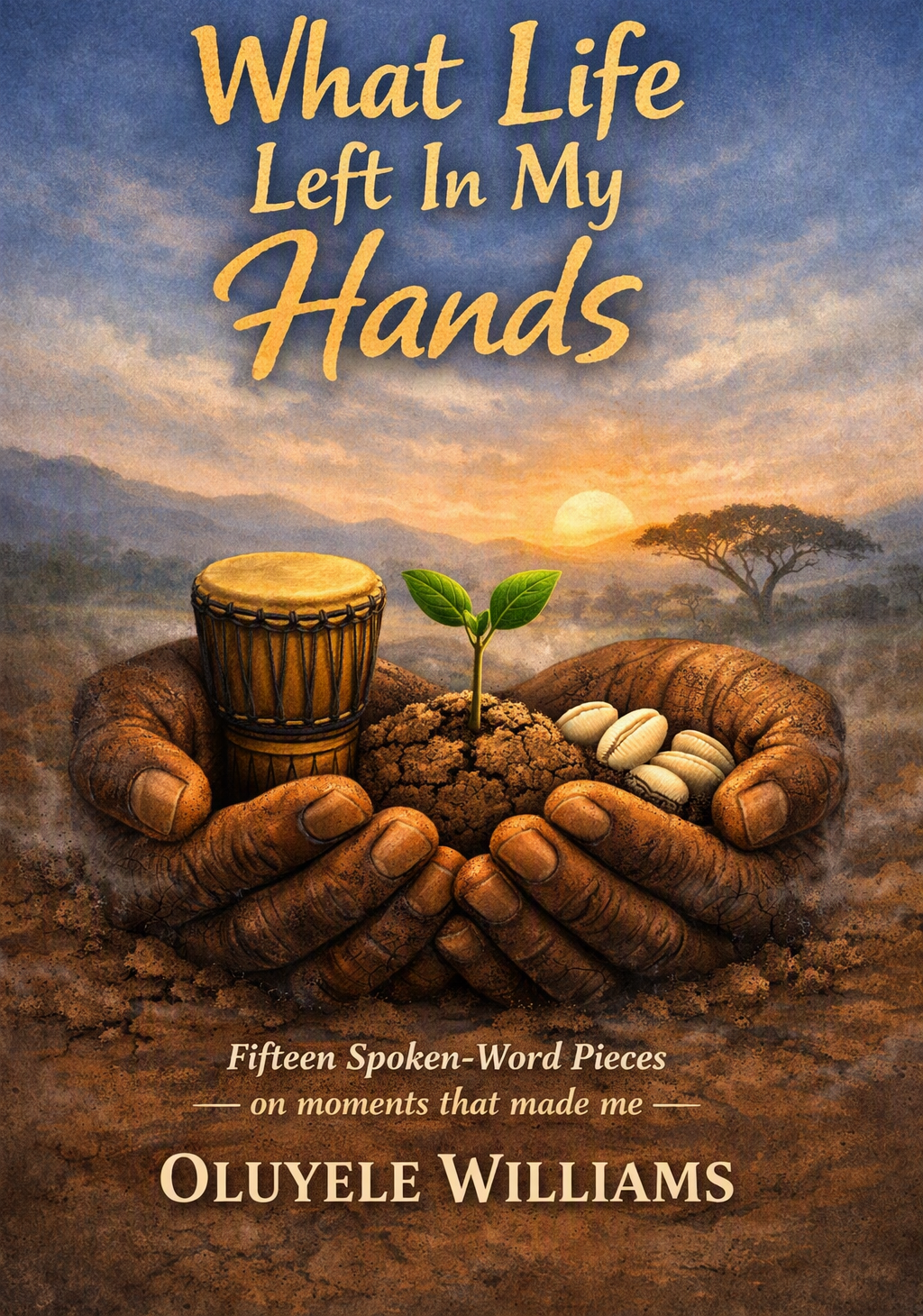
Book Details
Title: What Life Left in My Hands
Author: Oluyele Oyetunde Williams
Publisher: i2X Media
Edition: First edition, June 2026
Format: Fifteen spoken-word pieces