
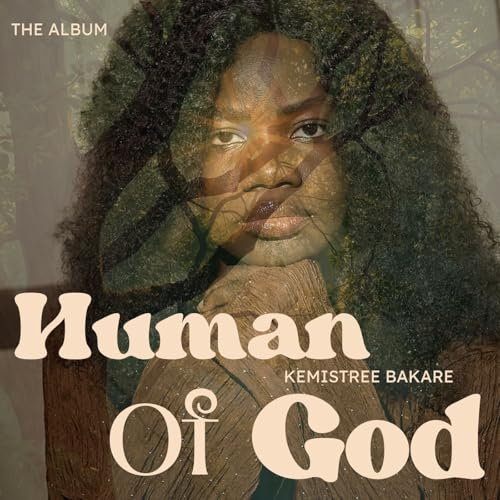
Human of God is a title waiting to be argued with.
“Man of God” and “woman of God” carry a peculiar reverence in Christian vocabulary. They suggest clergy, office, sometimes celebrity. Kemistree removes the gender and somehow brings the title back to earth. A human of God does not sound like someone who should require special seating at an event. It sounds embarrassingly available to everybody. Even the religious mind cannot escape the provocation. If you are human and belong to God, then perhaps you are a human of God. If not, whose human would you rather be?
That ordinariness may be the album’s most demanding proposition. Christianity here is not a specialist profession practised by unusually spiritual people. It is identity expected to produce consequence. Across eleven tracks, Kemistree asks what belonging to God should do to worship, ambition, gender, trauma, love, social responsibility and the stories we tell ourselves about ourselves.
Gratitude Poem begins as Yoruba creative endeavours often should, with homage before proclamation. “The poem is a funeral, yet a birthright.” Death and inheritance occupy the same line. One identity is buried so another can inherit its name. There is something of the born-again experience in it. Kemistree quickly enters self-eulogy, but her boast keeps returning to its source. She was given unclipped wings, made into dynamite capable of blowing up mental cages and religious prisons, her soul yanked out of comatose. The audacity belongs to her; its authorship, she insists, belongs elsewhere.
Then the Yoruba praise begins. Fear itself becomes afraid. Timidity is swallowed. God is rendered through hypnotic, melodious appellation until I am transported to CAC worship, to those older Yoruba Christians whose praise requires both theology and linguistic dexterity. Yoruba Christianity has mastered an interesting transfer of ritual technology. Words, structures and forms once deployed in indigenous praise are reclaimed and repurposed towards another altar. Not everything inherited has to be discarded. Sometimes language changes allegiance.
Melody to the Chief Musician moves from gratitude to responsibility. Worship, Kemistree says, is a love letter to the Most High, not merely singing. A love letter communicates intention. It declares allegiance.
“Grace is an empowerment scheme, not an excuse for sin.”
There is an entire theological quarrel inside that sentence. Using the gift of God is not necessarily the same thing as being used by God, and usefulness itself is poor evidence of intimacy. Cyrus was useful. Nebuchadnezzar was useful. Balaam’s donkey delivered a divine message. None of these examples gives the gifted person much room for swagger. God’s ability to accomplish purpose through a vessel does not automatically constitute His endorsement of the vessel. Kemistree therefore asks for more than gifted Christian musicians. Let God cease to be merely lyric. Let the worshipper become congruent with the worship. Sing until the song evangelises, but surrender until the life does too.
Shine takes that demand and goes to war with it. “A pe mi ni, mi o ran ara mi.” I was called; I did not send myself. What beautiful self-mythologisation in the realities of the new creation. There is an audacious buoyancy in believing oneself to be the emissary of a mighty one. Breath becomes rebellion against thrones of darkness. God asks Oluwakemi how His own can occupy a place and darkness remain comfortable. Light does not beg darkness for permission to shine. The embarrassment, then, is the light-bearer who has forgotten what she carries.
“Dying down for others to feel comfortable is not humility.”
Identity drives much of this album, and Shine states it almost without restraint. The veil is torn. The believer is grounded, difficult to uproot, speaking from the secret place, surrounded by holy fire. All that is about her is not gentle and kind. There are seasons in which the lion must appear. You leave the poem wanting to shine without permission.
Then Kemistree turns towards men. Man begins from a rather useful test: if God leads His prophets through patience, consistency and free will, from whom did men learn the language of violence? Who said maleness itself constitutes leadership, or that leadership means benefit without burden? If God does not erase a person’s agency, why should a husband require a woman to follow him blindly?
Her old sense of justice is intact. “Do you carry the response-ability to grow a flower into a garden?” After all, you call yourself a husbandman. Are you rooted in discipline and integrity, abi you no just like accountability? The poem is strongest when it refuses to reduce male responsibility to provision. Money matters, but a man can pay every bill and still be absent. It is an error to outsource value to trophies and income, then demand reverence for fulfilling only one part of responsibility. She acknowledges that men carry wounds, expectations and burdens, but she refuses to convert travail into victim mentality.
Popular Christian marriage teaching is sometimes remarkably fluent about female submission and strangely forgetful that the man is given the more murderous metaphor: love your wife as Christ loved the Church and gave Himself for her. If scripture can be weaponised to justify slavery and other forms of oppression, domestic scripture is hardly immune to opportunistic interpretation. Kemistree’s instruction to the man is ultimately simple: become.
I wondered whether she would spare the women. She does not.
Woman opens by returning one last blow to the men: Christ died so that everybody might truly be free, except women? If the cross crossed the curse, why should liberation stop at gender? But instead of spending the poem prosecuting men, she pivots towards women. That is the more useful move. “Woman, you are God’s 911 in a crumbling world.” Woman becomes strategist, nation-builder, an answer to ignorance and laws that bind her kind. Her voice is not silence. Society needs justice, and the future needs everybody. Kemistree refuses a feminism whose final ambition is simply personal escape. We cannot be building heaven while leaving our brothers behind. Freedom should make the liberated useful.
Then comes the track with which I argued most.
There Is Nothing Wrong with You begins from something true. Societies can be built to incapacitate unusual people. Institutions punish difference. Families can mistake nonconformity for failure. People are pushed towards self-doubt because what they carry disturbs an established mould.
“Pain is the building material for greatness.”
Perhaps. But not every pain is persecution, and not every discomfort proves exceptional destiny. Some suffering is pointless. Some is self-caused. Some is the consequence of a decision. Some discomfort is our inner genius fighting oppression; some is trauma or immaturity asking to be addressed. Even David had things wrong with him. The churches in Revelation certainly did. Moses and Gideon could list what they thought disqualified them, but God’s use of them does not establish that everybody’s self-doubt is necessarily false.
I am also wary of the motivational habit of calling everybody a genius. Every human being possesses dignity and can do things of immense consequence. That does not require us to empty “genius” of meaning. Christianity should need exceptionalism less, not more. God has an irritating habit of choosing foolish things to confound the wise. Kemistree eventually brings the poem back towards agency: “you will break the yoke when you become restless.” That I understand. Sovereignty is not an instruction to lie still.
But agency itself is unevenly distributed. Depression is not merely as real as we permit it to become, and there are people who cannot simply choose themselves out of psychological distress. Scripture itself prescribes community. Sometimes the faithful response is prayer. Sometimes it is counselling. Sometimes medicine. Sometimes all three. The poem may liberate somebody who has been falsely diminished. It should not become another accusation against somebody who genuinely needs help.
Special One feels less like an argument and more like an incantation. “The family history says no one has ever crossed the line, the pattern is ancient.” Here Kemistree speaks to herself. Mourinho is not the only Special One who understands the usefulness of unreasonable self-belief. History is full of people who required some mixture of faith, madness, rebellion, resilience and perhaps a little delusion to break a pattern everybody else had accepted as permanent.
“Wrong patterns are the price you pay for unprocessed pain.”
Kemistree becomes a woman in travail who simply will not rest. Trauma will not decide who she becomes. Dysfunction will not receive honour merely because it is ancestral. She shape-shifts anguish into fuel. She is not here to worship the problem. The poem is part dirge, part chant, part war cry.
Then AJ Babe goes home. An Afrobeats-inflected sound carries Kemistree back to Ajegunle and towards the girl she was. There is a secondary-school photograph of her from around that period. She is staring into the camera with the sort of scowl that suggests nobody should try nonsense. It suits the poem.

She remembers an environment where teenage pregnancy could easily have written another ending, where Ajegunle itself came packaged with assumptions about social rejects, abandoned projects, pickpockets and gutter behaviour. She refuses all of it. White pap can come from black pot. Root is not fate. She has street OT. She has swallowed the Holy Ghost. More importantly, she has a coconut head with direction.
I met Kemistree at the Eko Poetry Slam around 2014. She won. I came fourth, tied with Paul Word. I remember wondering who this brilliant poet was and trying to become her friend. She was, in many ways, exactly what AJ Babe now says she was: fiery, stubborn, talented, winning slams while trying to pay tuition, already unwilling to allow circumstance to become prophecy. Talent choke, yes. But the poem refuses talent without motion. Are you actually becoming a light capable of summoning kings, or merely someone’s plaything?
I’m Not Crazy continues the rebellion, but now the argument is with normality itself. Kemistree insists she is not crazy because she sees hierarchies and exclusions Christianity claims to have dissolved. She is “not the only glitch” in conflict with the silent web of lies. Perhaps madness is simply the ordinary person’s diagnosis of a seer. Her reality refuses to match the limits of what society has imagined for her.
“This world is a haunted house. The truth is a flickering light.”
She sounds like a mad prophet screaming from a mountain while everybody else strolls comfortably towards Jericho. Then she ends with a mad crackle, as though conceding that perhaps refusing to go mad in a mad world would be the stranger decision.
After all that fire, Helplessly in Love remembers tenderness. “Every time you stare at me, time loses concentration.” This is signature Kemistree, intoxicated with metaphor. A Song of Solomon that does not see why Genesis, Jericho, the moon and eternity should not all participate in romance. “Not loving you will lead the moon astray.” The walls of Jericho crumble without anybody singing hallelujah. The poem needs to be sipped.
And although the recording arrived much later, Helplessly in Love is an old Kemistree poem to me. I had heard her perform it on stage years before it received this recorded life. That history is important because it reveals what Human of God actually is. It is not simply a new religious Kemistree replacing an older poet. Old poems, old preoccupations and old fire have been gathered under a clearer organising centre.
Then comes Human of God itself, a gang-up by multiple poets against misconceptions of identity, an ambush rather than a solo declaration. I am part of that gang-up, so I will resist the temptation to review myself. But its position makes sense. Identity has been running underneath the album all along. Who are you when God names you? What does that naming demand of gift, ambition, gender, pain, love, history and voice? The title track gathers the question in plurality.
For me, that is the real achievement of Human of God. Kemistree’s theology has become more than Christian vocabulary pasted onto poems that would otherwise remain unchanged. It increasingly reorganises the questions themselves. Grace must produce something. Calling must produce something. Freedom must produce something. Identity must produce something.
I do not agree with every answer. I would not trust an album that required me to. Kemistree occasionally allows certainty to outrun complexity. Her self-mythology can approach the motivational temptation to read every obstacle as evidence of extraordinary destiny. Some pastoral claims need qualification. But Kemistree has never been a poet built for whispering until every caveat is satisfied.
Her native language is fire.
The difference is that the fire has found an altar.
And perhaps that is what Human of God finally asks of its listener. “Man of God” can remain somebody else’s title. “Woman of God” can remain an ecclesiastical category. Human of God leaves fewer places to hide.
What kind of human are you becoming if you say you belong to God?
Kemistree spends an album answering. The most convincing moments are the ones where the answer sounds less like a slogan and more like evidence.
Album Details
Album: Human of God
Artist: Kemistree Bakare
Released: 30 April 2026
Format: Spoken-word / poetry album
Tracks: 11
Listen:
Spotify ·
Apple Music ·
Audiomack
Track List
Collaborating Artists
GRATITUDE POEM
Juwon Oriki
MELODY TO THE CHIEF MUSICIAN
Tiwa Macaulay
Uche Uwadinachi
SHINE
Uche Uwadinachi
HELPLESSLY IN LOVE
Sammypraise / Sammy Praise
HUMAN OF GOD
KJ
Uche Uwadinachi
Vic’Adex
Samurai
Graciano
Juliet Nnaji
Jay Supka
Sambakz
Tiwistar
Thrive
Tobi Adeyemi
Paul Word
Prestige
LionessTaffy
Saheed Sunday
About Kemistree Bakare
Kemistree Bakare is a Nigerian spoken-word poet whose performance career stretches back more than a decade. She won WordSlam in 2011, the Eko Poetry Slam in 2014 and the Abuja Literary Slam in 2015, and has performed across major Nigerian literary and poetry platforms. Her work has long combined energetic performance, social critique and recurring concerns with freedom, identity, justice and faith.