
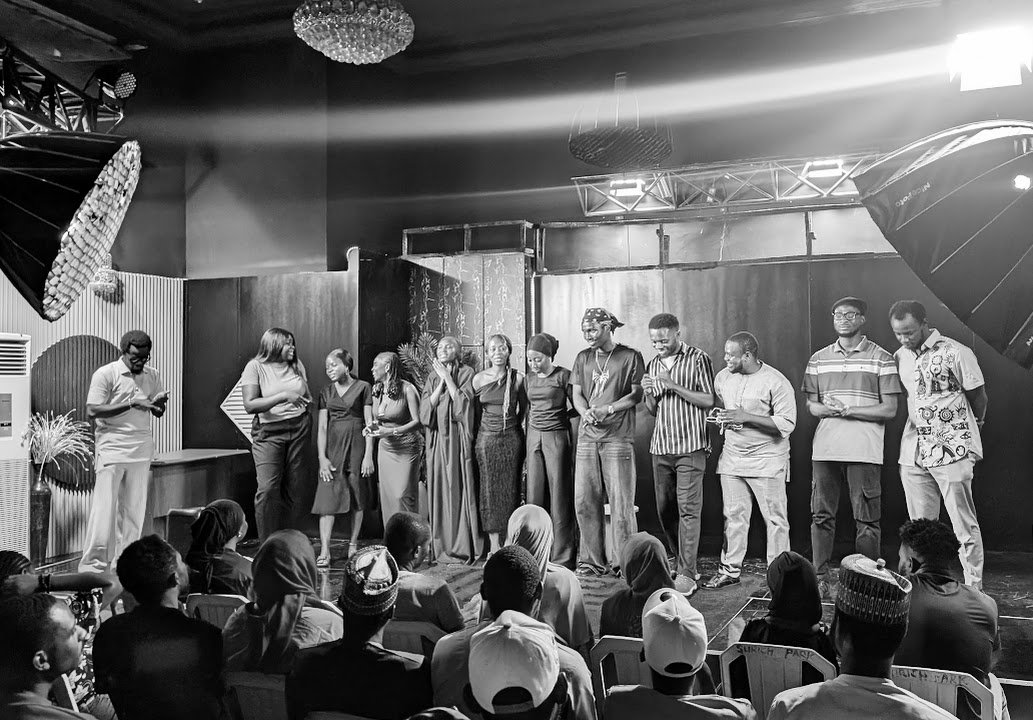
There is nothing ordinary about any of Pariolodo’s productions. Calling his latest show Ordinary People must have been a mastery of misdirection and mischievousness. The phrase almost always points away from the person using it. Ordinary people are the market women, the voters collecting rice, the couples fighting behind closed doors, the mothers-in-law policing fertility, the people who still believe elections can save them, and the people who have stopped believing anything can.
We, meanwhile, are the observers. We have vocabulary. We know words like patriarchy, clientelism, structural violence, voter inducement, gender-based violence, learned helplessness. We can identify the pattern. And perhaps that is precisely the danger. The ability to name a thing can create the illusion that one stands outside it.
I pondered on that through Ordinary People, a collection of minimally staged, actor-led performances that moved between marriage, politics, violence, poverty, hope and survival. The show did not seem particularly interested in saints or villains. It was more invested in exhibiting people. The nuances of their ordinary, seemingly innocuous lives. People who suffer and inflict suffering. People who are correct for the wrong reasons and wrong for understandable ones. People who condemn systems they participate in and participate in systems they condemn. The evening gave me more than enough to think about, and curiously, the best place to begin is not where the evening began.
Two performers dressed as ballot boxes arguing about Nigerian democracy ought to be ridiculous. It was. It was also probably the most intellectually satisfying performance of the evening. One ballot box was optimistic, the other pessimistic. Between them sat the Nigerian democratic experiment, repeatedly disappointed, repeatedly resurrected. The pessimist had history on its side. Elections fail. Technology fails. Institutions fail. One moment things appear steady and the next, as Nigerians would say, kasala don burst. The optimist had something weaker but perhaps more necessary: possibility. That is the uncomfortable thing about democratic participation. Evidence can make pessimism rational while responsibility still demands action. The performance understood this contradiction. There were clever jokes everywhere. “Even if your sperm doesn’t count, let your vote count.” A ballot box could literally get “carried away.” Inside Aluta, a gentleman no dey. But underneath the wordplay was a serious struggle over whether hope is wisdom or merely a socially useful delusion. The piece did not fully resolve this for me, and I am glad it did not. It leaned towards mobilisation without pretending that optimism had intellectually defeated pessimism.
We often tell people that “change is a marathon.” It sounds wise. Sometimes it is wise. But phrases like that can also become anaesthetic. How many decades can people be asked to endure in the name of gradual change before patience becomes another technology of political control? Did Martin Luther King Jr. not warn against the “tranquilizing drug of gradualism”? Still, refusing participation because the system is compromised merely surrenders the system to those already exploiting it. So one ballot box may have been right about the evidence and the other right about the obligation. The tragedy is that citizenship sometimes requires us to act before hope has proved itself reasonable.
That tension between what people know and what they still do connects the ballot boxes to Just Dead, for me the most predictable performance of the evening. But I am not certain that predictability is entirely a weakness when the thing being dramatised is itself horribly repetitive. It begins beautifully enough. A woman speaks of the kind of man who knows “the corner of your mind”, not merely your body. There is romance. Familiarity. Domestic responsibility and submission. She makes his favourite meal. Football metaphors enter the courtship. A man must “move like Haaland” to land her. Men dribble so long that they become the best man rather than the right man. Somewhere in all this sweetness is the recognisable fantasy that another human being can make the monotony and biting bureaucracy of capitalism survivable.
Then a disagreement over food becomes something else. He asks her to eat. She refuses. He insists. She refuses. He slaps her. And suddenly the predictable script unfurls before us. Violence quickly followed by an apology buried in explanation. He asks for forgiveness in an obvious performance she knows too well. It is the kind of performance we sometimes see on Sunday morning from people who think God owes them forgiveness and use repentance as a get-out-of-jail-free card. He promises, “It will never happen again,” but every addict knows those words can become a glorious lie made believable through self-deception. She even excuses his behaviour, calling the slap a “tender palm of correction.” Abuse is creative. She becomes the source of vehemently beautiful euphemism. Violence laundering itself through tender language.
The wife stays. “This is what love is,” she says. That line bothered me more than the slap, because people do not always remain in violent relationships because they are ignorant of violence. Sometimes they remain because love itself has been rearranged inside them to accommodate violence. Survival, affection, fear, memory, dependency and hope begin occupying the same room. Unsurprisingly, and almost as expected, he dies from the meal. This was where my mind went, strangely enough, to Michael Corleone in The Godfather, and to similar moral metamorphoses in contemporary crime drama: the moment a character crosses into an action that makes returning to their former moral self impossible.
She does not become innocent because he abused her. He does not become less abusive because she kills him. Both truths remain. That is one of the instincts I liked most about Ordinary People: victimhood does not automatically produce moral purity. “Come and bury yourself inside my body, there is enough depth to mourn for you” carried the sexual tension of the relationship while already sounding, retrospectively, like a funeral. In the end, he dies through the food he loved. She watches. Police sirens arrive through the speakers. No clean revenge fantasy. No easy liberation. Two people failed by themselves, by each other, and by the social scripts they inherited. The circle closes. But violence is not the only thing in Ordinary People that moves in circles. So does blame.
That circularity is clearest in The Abandoned, where Mama Ejiro sits with vegetables that are barely selling. Before the political argument properly begins, the script establishes the conditions around her: insecurity, a daughter who has finished school but still cannot find decent work, dependence on money sent home, a stagnant market, the exhausting business of simply trying to manage. Then a politician arrives and buys everything. Five thousand naira. Mama Ejiro celebrates. Honing in on that reaction is important. Five thousand naira is not merely five thousand naira in the scene. It is evidence of how deprivation alters the scale of generosity. What might be trivial to one person can feel providential to another.
The politician listens while she complains about the country. Prices rise. Politicians’ stomachs rise. Then comes one of the best jokes in the script: “The only thing wey no dey rise na the rice wey dem share last election.” The rice, unlike inflation, did not even survive two weeks.
Then the politician begins to push back. Everybody blames government, he says. Nobody accepts responsibility. People vote. People collect rice. People vote tribally. People jump queues, bribe institutions, ignore traffic laws, exploit one another and then complain about corruption as though corruption were an exotic animal imported into Nigeria by politicians. The script lets him make the argument properly because he is not written as an idiot. On stage, he sounded reasonable. And irritatingly, much of what he says is true. The average Nigerian can be dubious while hating dubious systems. We resent being exploited and then exploit whoever falls beneath us. We condemn corruption at scale while negotiating exceptions for ourselves.
But then the argument begins to eat itself. When Mama Ejiro realises what is happening and attempts to reject his money, he reminds her what refusal will cost. Her children are hungry. Her husband is sick. She needs transport. She still has goods to carry. Later, he repeatedly asks: who forced them? Who forced the market woman to collect rice? Who forced the thug to steal the ballot box? Who forced the lecturer to take money? Who forced the professor to alter election figures? But the scene has already demonstrated something more complicated than force. Nobody forces Mama Ejiro to take the five thousand naira. But her situation makes refusing it costly.
That is not the absence of agency. Neither is it completely free choice. This is where Nigerian arguments about leadership often become intellectually lazy. “People get the leaders they deserve” contains enough truth to feel profound while often ignoring the unequal distribution of power. The citizen participates in corruption. Yes. But poverty can be weaponised. Ignorance can be cultivated. Institutions can be weakened. Politicians can manufacture conditions in which immediate survival repeatedly defeats long-term civic interest. Ordinary Nigerians may be culpable without being equally powerful.
Mama Ejiro understands this instinctively when she tells him, in effect, this country has never happened to you. There is a difference between understanding Nigeria and having Nigeria happen to your body. The politician eventually reveals himself openly as Olowokere Ayokele Thomas, a candidate for Local Government Chairman, and asks for her vote. It is not really a twist. We already know what kind of man he is. We have just watched political patronage assemble itself. Buy the woman’s goods. Listen to her suffering. Explain why she is partly responsible for that suffering. Offer yourself as the corrective. Ask for her vote. The irony is almost too perfect: he criticises transactional politics while practising a more sophisticated version of it.
But Mama Ejiro has changed slightly by the end. She does not reject voting. She does not reject him because he is a politician. She asks for a track record. What have you done, as an ordinary Nigerian, to improve people’s lives? “No be cho cho cho again.” That may be the most useful political proposition in the whole scene. Not blind hope. Not blind cynicism. Evidence. And this is where the earlier ballot boxes return for me. The performance about democracy asks us to keep participating despite reason for pessimism. The Abandoned adds a condition: participation without interrogation merely reproduces the same theatre. A vote for change does not tell us whether the change will be better. “Change” is morally empty until we ask: change into what, led by whom, evidenced by what?
The same suspicion of easy explanations appears in I Want Your Mother Dead. The title begins like comedy. A wife tells her husband she wants his mother dead. The mother-in-law arrives in a familiar Nigerian dramatic costume: intrusive, suspicious, invested in her son’s fertility, willing to find another woman for him, willing to treat the wife’s inability to conceive as sufficient evidence of guilt. The audience laughs because we recognise the stereotype. Then the piece begins stripping away the comfort of recognition. Infertility, predictably, has been treated as a woman’s problem. It turns out the husband is the one with the fertility problem. Then another woman claims to be pregnant for him. That claim is false. Meanwhile, the wife becomes pregnant by another man. Suddenly everyone’s certainty about reproduction becomes unstable. The woman labelled barren can conceive. The man imagined to be fertile cannot. The supposed mistress is lying. The marriage now contains actual paternity fraud. Everybody has been wrong about somebody.
This is where Ordinary People seems most comfortable: inside moral disorder. The mother-in-law stereotype is not simply overturned so that the wife can become morally pure. Instead, the performance creates a network of injury, deception, social pressure and reproductive anxiety. It also reminds us how deeply fertility can become a public performance in marriage. Two people marry, then somehow parents, relatives, neighbours, churches and entire communities become shareholders in the womb. Pregnancy becomes proof. Childlessness becomes accusation. Masculinity becomes fertility. Femininity becomes motherhood. And when biology refuses to cooperate with the social script, somebody must be blamed.
The piece starts funny because these stereotypes have become culturally familiar enough to entertain us. It becomes painful because familiarity does not make them harmless. That tonal reversal happened repeatedly through the evening. Ordinary People invites you to laugh and then quietly asks whether you have noticed what you were laughing at.
By the time the final poem arrived, there was much less laughter available. This was the emotional anchor of the evening. There are moments in theatre when analysis becomes almost indecent. The final performance moved through child marriage, homelessness and lives in which sacrifice arrives too early. The lead says, “sacrificing myself to be the hero for my family.” There are children who become economic strategies. Girls whose bodies become negotiations. People whose suffering is not hidden because nobody knows it exists, but because knowing properly would impose obligations on us.
The poem accused us, in effect, of not asking questions. Perhaps because questions produce answers. And some answers are inconvenient. The intellectual pleasures of the evening largely disappeared here. No ballot boxes arguing. No political apologist to debate. No poisoned food waiting to become metaphor. Just the weight of lives that social analysis can sometimes make too clean. It was the perfect landing because the evening had spent so much time asking us to interpret ordinary people.
At the end of the day, what exactly was I watching? Performance poetry becoming theatre? Theatre invaded by performance poetry? Applied theatre with a poet’s obsession with memorable lines? The tension produced some of the evening’s best moments. Poetry wants compression. It wants the unforgettable phrase. “Desire for miracle na addiction / And na testimony dey fuel am.” Those are poet’s lines. They want to survive the scene. They want to be repeated afterwards. Applied theatre asks slightly different questions. Does the audience recognise itself? Does the encounter alter anything? Does embodiment make an argument available to people who would never read a policy paper? Does the performance produce conversation beyond applause?
The two forms can strengthen one another, but there is a trade-off. A line can become so clever that we admire the writer instead of confronting what the line describes. A message can become so explicit that poetry is reduced to advocacy copy. A character can become so useful as a vessel for an argument that the human being disappears. To its credit, the performances mostly avoided that last danger. Even the shared, aphoristic sections felt natural on stage, more like the banter of people who know how these arguments go than a playwright forcing theory through their mouths. Still, the larger question remains. What happens when poetry is asked to perform civic labour? And how much civic labour should we reasonably demand from poetry?
I loved the show. That deserves to be said without qualification. I enjoyed myself. I laughed. I was surprised. I was intellectually irritated in useful ways. I felt that peculiar relaxation theatre can give: the mind remains active, but the stimulation is clean. For a few hours, somebody else gives your brain something to wrestle with that is not an email, deadline, notification, outrage cycle or the ambient anxiety of being Nigerian. There are worse ways to de-stress. There are certainly more toxic ones.
But enjoyment eventually returned me to the question hidden inside the title. Who exactly is this for? Who sits in a room watching a market woman sell political agency for survival? Who understands the jokes? Who has the time, transportation, literacy, vocabulary and cultural inclination to spend an evening watching Nigeria explained back to itself? And then the more uncomfortable question: does socially conscious theatre sometimes become an intellectual exercise in which relatively educated people sit together analysing the failures of “ordinary Nigerians”? We know why they collect rice. We know why they vote tribally. We know why abusive relationships persist. We know why corruption reproduces itself. We even have theories. Perhaps knowing the names of the patterns makes us feel slightly superior to the people trapped inside them.
But knowing the word “clientelism” does not make one immune to connections. Knowing “patriarchy” does not automatically remove entitlement. Knowing “structural corruption” does not prevent us from jumping a queue when somebody important recognises us. We excuse our preferred politicians. We exploit advantages. We invoke tribe selectively. We dislike corrupt systems and negotiate private exceptions to their rules. We are capable of describing precisely the behaviours in which we still participate.
And perhaps this is where the spiral closes. The ballot boxes argue about whether we should still believe. Mama Ejiro argues about who is responsible. The politician argues that Nigerians create the systems they complain about. The abused wife becomes violent herself. The infertile marriage collapses under everybody’s certainty about who is to blame. The final poem asks us to look at lives we would rather reduce to social categories. Each performance appears to be about somebody else until the distance becomes difficult to maintain.
Maybe that is where Ordinary People becomes most useful: by destroying the comforting distance between observer and observed.
The market woman is ordinary. The abusive husband is ordinary. The wife who crosses from victimhood into violence is ordinary. The politician who can correctly diagnose a problem while benefiting from it is ordinary. The pessimist is ordinary. The optimist is ordinary. The person in the audience who can identify all their contradictions and attach theories to them is ordinary too.
Perhaps the most dangerous thing about calling a show Ordinary People is the temptation to believe the title refers to somebody else.