
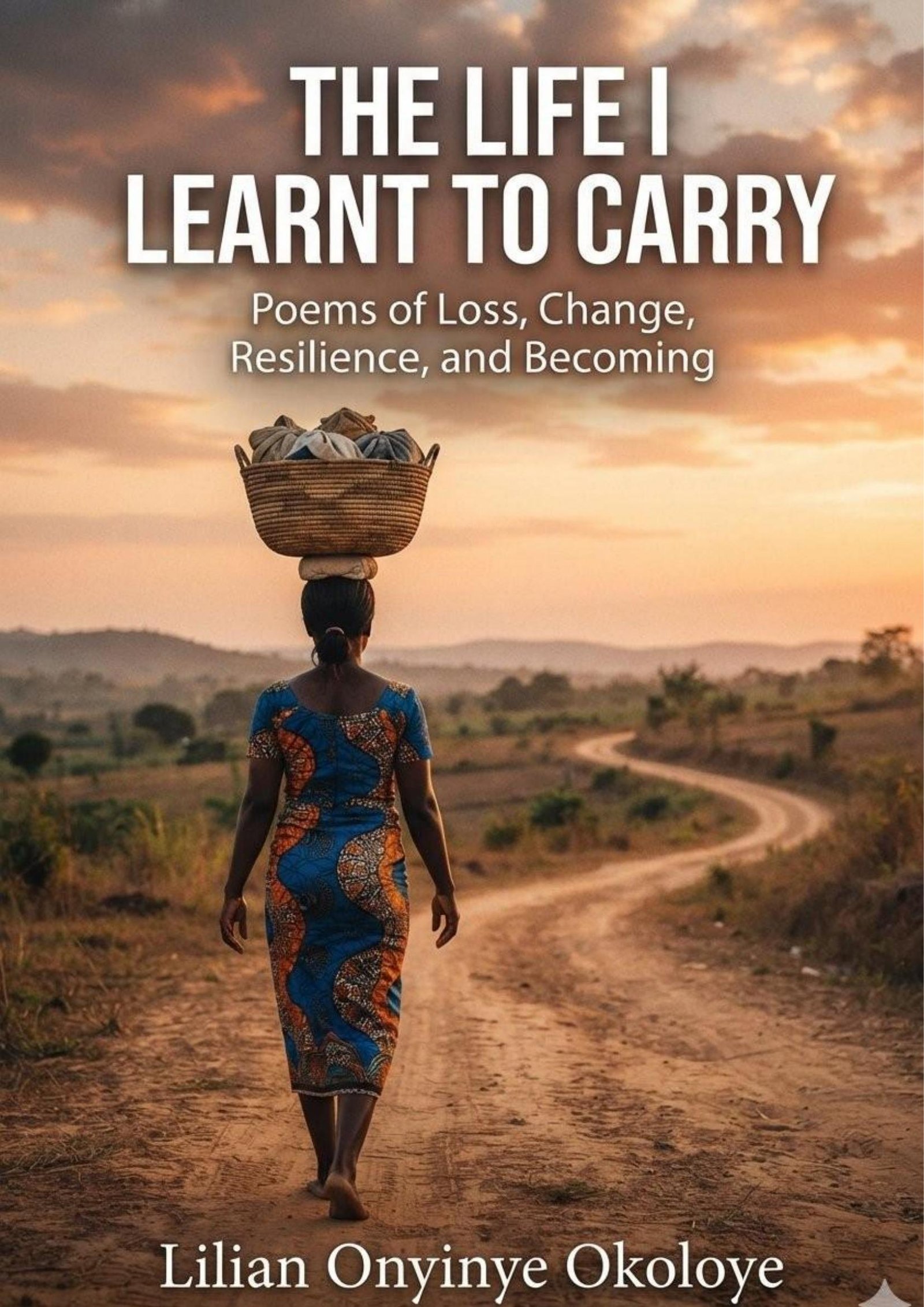
A review of Lilian Onyinye Okoloye’s The Life I Learnt to Carry
Before ever having to carry grief, responsibilities, or the other burdens of adulthood, there was a girl living beneath a familiar roof, nursing dreams that had not known the disease of reality.
This is where I prefer to enter Lilian Onyinye Okoloye’s The Life I Learnt to Carry, near its end in “When Life Still Felt Open”. There, family is “the quiet architecture of my courage”, and the speaker discovers that a particular confidence grows from being loved before achievement. That line may be the key to the collection.
But what exactly are we learning to carry? At what point does resilience become accommodation to ordinary chaos? And what makes one person able to carry without disappearing beneath the weight? Okoloye’s childhood poem offers one answer. Home, the village that raises a child, supported her before she could understand support as privilege.
When disappointment came,
home remained.
There is a particular kind of confidence
that grows from being loved
before you have achieved anything.
Before Britain, there is Lagos. “Miles Before Morning” is unmistakably an ode to Lagos traffic married to Lagos struggle. Before the workday begins, the speaker has already travelled. The city consumes sleep, fare, and bodily energy before the office receives its first hour of labour. The poem itself begins to distrust endurance. Commitment has a cost. Dependability becomes dangerous when it makes a person forget she is human. The office should not feign ignorance of the chaos outside its windows.
Then comes Britain, where belonging itself has to be learnt. “The Country I Imagined” is an antidote to the fanfare around japa. Departure is often narrated from Nigeria as glorious arrival: airport pictures, pounds instead of naira, a new flag in the bio. For Okoloye, it is neither that seamless nor glamorous.
“Arriving somewhere / does not mean / you have arrived.”
There are unfamiliar covers, cold that settles into the bones, and the discovery that even belonging has procedures. The migrant can be grateful and lonely at once.
“The Job Hunt” turns that displacement into a crisis of professional legibility. The speaker arrives with certificates, experience, and “a CV carefully folded into the shape of possibility”. Then the bureaucracy of employability begins. Years of labour are compressed into boxes and bullet points. The immigrant who knows what she can do must learn the precise combination of words that will persuade somebody else to recognise it.
carrying confidence in one hand
and uncertainty in the other.
The job hunt may as well serve as a metaphor for the Nigerian dating scene, where people reinvent themselves to become more desirable. The anxiety is the same: how much of yourself can you keep editing before you begin to wonder whether the problem is you?
Okoloye’s answer is characteristically didactic. Like a proper Nigerian, she finds a lesson inside the suffering. She was not empty-handed, she tells herself; she was simply in a place where her experience had to be translated. Popular appeal endures partly because it works, and maxims survive because people keep finding themselves in them.
Still, I wonder about the border between reframing hardship and excusing a system that should work better. The poem ends without the desired job, only the decision to keep knocking. What does sustained hope do to the body before it becomes another form of labour? When the desired email comes, will the body exhale, or will it have learnt to stay on guard for the next conquest?
That tension runs through “The Day I Got Lost”, “Learning the Roads”, “A Different Classroom” and “Culture Shock”: an intelligent adult can suddenly become a beginner.
Unfamiliar systems can make capable people doubt themselves.
Her competence has entered a culture whose ways she does not yet understand. British privacy can resemble coldness to someone raised inside a warm Nigerian social life.
In “Who I Chose to Be”, hostility is answered with restraint and professionalism. In “What Was Poured Away”, family conflict produces anger so immediate that the heat in the speaker’s chest becomes almost indistinguishable from the words forming in her mouth.
For a moment
anger rose so quickly
I could hardly separate
the heat in my chest
from the words
forming in my mouth.
Again, strong emotion is subjugated into the service of ethics. The speaker chooses peace without pretending the disrespect was acceptable. Admirable, yes, but where does all this anger go? The body does not always accept the verdict of the mind. Sometimes anger leaves the mouth and enters the shoulders; sometimes disappointment becomes vigilance.
I wanted some of the poems to stay inside uncertainty longer. Really carrying something implies weight and time. Otherwise, perhaps these are merely things we pick up, not things we carry.
“Trust Has a Price” is a heartbreak that has Yoruba demon or Abuja big boy written all over it. We know the archetype. There is always a business, a project, a glorious future being “manifested”. And somehow the woman’s generosity is one of the financing models.
The speaker gives away NYSC savings because she believes she and the man asking for it are standing on the same side of the door. Instead, she loses money, trust and an imagined future.
But does love not make mumu or mugu of all of us?
Her embarrassment is one of the poem’s most believable emotions. She asks not only how he could deceive her but also how she allowed herself to be deceived. But Okoloye repeatedly extends grace to her younger selves, refusing to punish the woman who believed somebody was sincere or to prosecute herself for not knowing what ordinary days would later mean. The woman who knows better does not humiliate the woman who did not know yet. It is something many of us still need to learn.
Grief, interestingly, is treated differently from anger. Anger is expected to become useful. Grief is allowed to misbehave. “When You Left” understands grief through interruption. A meal, a voice, a phone, an ordinary memory becomes a trapdoor:
I thought losing you
would be one terrible moment.
I did not know
it would become
a thousand little moments
afterward.
People offer the familiar consolation that the dead are in a better place. The speaker answers, essentially: maybe, but today I just need my mother. There is something refreshingly undiplomatic about that “maybe”. Grief does not owe anybody philosophical composure or closure.
“Two Empty Chairs” deepens the loss. The speaker has barely learnt how to miss her mother when her brother dies, and the grief she carries must make room for more. Unlike the anger poems, this one allows disorder to remain disorder: grief circles and returns; the speaker moves forward without pretending she has moved on. Why, then, is grief allowed to remain unresolved while anger must become wisdom? Perhaps because death resists the collection’s ethic of self-improvement. No better CV, boundary, budget, route or response will return the dead. Grief cannot be solved, so the poet finally allows carrying to mean carrying.
And this is where the collection returns home. “The Weight of Ordinary Days” takes us back to meals, family conversations, laughter, photographs and all the things that seemed too small to deserve attention while they were happening.
“We ate together / without knowing / we were rehearsing absence.”
Loss has revised the value of the ordinary. She now stays longer when family gathers and notices the table because she knows tables do not remain full forever. We have returned to the childhood with which I began, but it is no longer the same childhood.
This autobiographical simplicity is one of the collection’s strengths. The language is accessible, conversational and rarely obscure. These poems want to be understood. But simplicity and economy of words are not the same thing. Many poems are long, and too often the poet continues explaining after the image has done the work.
Where the collection succeeds, it shows resilience as relational rather than magical. People endure partly because somebody once loved them well. It is not unusual to want to make experiences mean something, but I am not always convinced that pain owes us that service. Sometimes pain is just pain.
Yet Okoloye is persuasive when she distinguishes between what must be put down and what can only be carried differently. The mother’s memory cannot simply be put down. The brother cannot be replaced. There is, then, dignity in carrying things. There is also dignity in putting things down.
The difficult art is knowing which is which.