
What Water Carries
Michael Imossan, Tares Oburumu and the Histories Poetry Refuses to Bury
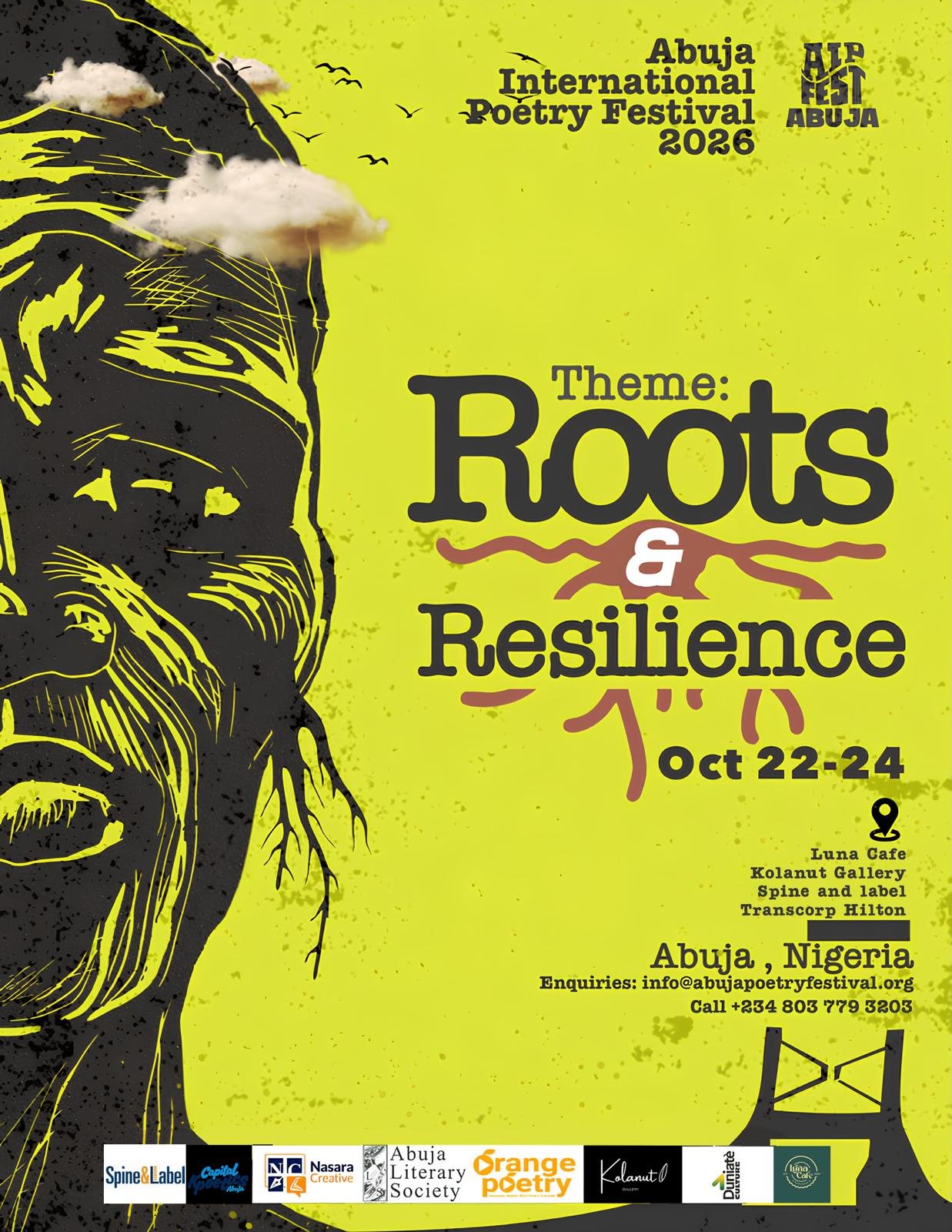
Inherited Tongues: Voices from Where We Come From · Abuja International Poetry Festival, 22 October 2026
A church stood where much else had been destroyed.
It sounded almost too convenient as a poetic image. A church surviving the devastation of an entire community, rising from the rubble like Christ. Yet, when Tares Oburumu was asked about the image during Inherited Tongues: Voices from Where We Come From, he explained that it had emerged from something he had witnessed.
According to Oburumu, he had visited a village near his hometown that had been destroyed in an operation he attributed to the Nigerian military. Amid the devastation, a church remained standing. He had preserved that experience into his poem, A Small Town of Love by the Sea, where he described the church as the only thing that rose from the rubble.
The poem was one of several readings during the 5:30–7:00 p.m. virtual session of the 2026 Abuja International Poetry Festival, hosted by Ella Fortté and featuring Oburumu alongside fellow Nigerian poet Michael Imossan.
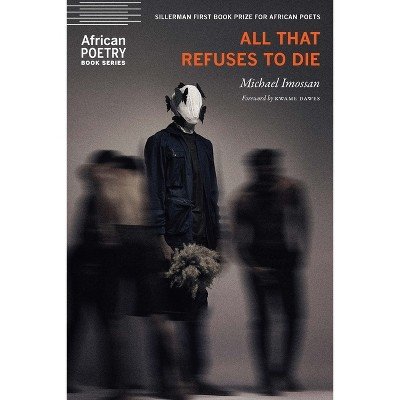
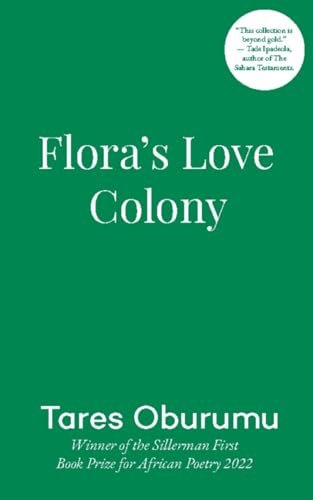
Both poets are recipients of the Sillerman First Book Prize for African Poets. Oburumu won in 2022 for Origins of the Syma Species, while Imossan received the 2024 award for All That Refuses to Die. Oburumu’s later collection, Flora’s Love Colony, was also a finalist for the 2026 Nigeria Prize for Literature.
The readings travelled through water, migration, childhood trauma, language and colonial inheritance. What made the session particularly interesting, however, was the conversation that developed around the poems and the different ways the poets understood what they were writing against.
For Imossan, geography offered an entry into history.
Both poets come from Nigeria’s coastal regions, where rivers and the Atlantic Ocean are part of everyday life. Imossan reflected on that shared geography while reading from All That Refuses to Die, particularly the sequence A Lineage of Water.
His rivers carry more than water. There are fishermen, markets, children, canoes, people travelling towards cities beyond the poet’s immediate view. There is also the Atlantic and its history of enslavement, the movement of bodies and the violence through which communities were separated from their people.
The language of the sea, Imossan tells us, is sorrow. Yet the sea must still be spoken of.
“The language of the sea, Imossan tells us, is sorrow. Yet the sea must still be spoken of.”
One of the more compelling aspects of the reading was how ordinary life occupied the same geography as historical violence. A fish market comes alive in the morning. Children relieve themselves into the water. A fisherman who has stayed too long at sea is returned to his people, bloated. The river is neither a pristine symbol of ancestry nor merely a historical monument. It remains part of people’s lives, carrying their ordinary transactions alongside older histories of loss.
When Imossan moved from the Atlantic to Nigeria’s contemporary political realities, he chose to read Three Nigerians, explaining that he had initially considered a poem about conflict in Congo. The poem concerned the discomfort of entering spaces where one’s ethnicity appeared to matter more than one’s nationality. In an office occupied by men in flowing kaftans, the speaker contemplated surrendering his cultural identity simply to become visible and acceptable.
"Ethnicity before country."
That phrase carries a peculiar indictment of the Nigerian condition. The speaker belongs to the country, yet belonging to the country does not necessarily secure acceptance within its institutions. He considers abandoning his own cultural markers and adopting another’s, hoping that familiarity might open a door that citizenship alone could not.
The audience discussion subsequently moved towards personal history and healing. Asked what had given him the courage to let go of painful experiences, Imossan resisted the suggestion that letting go was something he had already accomplished.
For him, it remained a continuum. He described sitting with anger, rage and the circumstances of his upbringing, questioning where those emotions came from and how they had shaped him. Poetry became both a psychoanalytic undertaking and a search for catharsis. Even the completion of a collection did not necessarily bring that search to an end.
He also discussed a newer manuscript, Kneeling Inside a Wound, which draws on his relationship with his father and an imaginative reconsideration of Christ’s search for the Father. Ella Fortté took the conversation further by returning to an image from one of his poems: being both wound and scar.
How does someone carry the injury and the evidence of healing simultaneously?
Imossan’s response suggested that understanding had helped him negotiate experiences that might otherwise have left him with greater anger. Knowledge, he argued, could aggravate an injury while also providing some freedom from it.
I find the distinction important, although it raises another question. There is a point at which understanding why someone caused harm can begin to resemble excusing the harm itself. Knowing the circumstances that produced another person’s behaviour may help us interpret what happened without necessarily making that behaviour acceptable. But the contradiction is real. People can continue carrying the consequences of experiences they have intellectually understood or emotionally forgiven. Healing does not mean the man is left scarless.
“Healing does not mean the man is left scarless.”
Imossan also offered an interesting perspective on the place of storytelling in poetry. He argued that all poetry involves some form of storytelling, whether linear, fragmented or lyrical. His concern was that narrative spoken-word poetry could become so dependent on plot and explanation that it lost its poetic qualities. He encouraged attention to imagery, sound and wordplay, confessing a preference for puns over punchlines.
There is room to disagree about precisely where poetry ends and prose begins, particularly in performance. Yet his concern about craft is worth considering. The importance of an experience does not automatically guarantee the quality of its artistic expression.
Oburumu approached the readings somewhat differently.
He announced that he preferred not to explain his poems, believing they should be allowed to speak for themselves. Reading from Flora’s Love Colony, he began with The Love Affair, a poem about a young girl whose father had died during violence in northern Nigeria.
The girl could speak English. Her mother could not understand it.
“The girl could speak English. Her mother could not understand it.”
Oburumu explained that the language had become a source of sadness for the mother, who was already negotiating bereavement. It is an interesting way of examining inherited tongues. Language ordinarily allows people to communicate across experience, yet it can also introduce distance between people who already share a history and a home. A mother and daughter may inhabit the same family while becoming increasingly unfamiliar with one another’s means of expression.
The session moved through other poems concerned with migration, racial identity and the pursuit of opportunity beyond one’s homeland. In In Faraway Georgia and A Brave Ship Story, Oburumu explored the experience of movement and the complicated promises attached to life elsewhere.
Then came the surviving church.
Asked whether the image was intended to offer hope amid devastation, Oburumu explained its origins in the village he had visited. The discussion became more complicated when Imossan asked how a writer who did not identify with Western religions reconciled the use of Christian symbols in his poetry.
Oburumu’s response was that Christianity and other imported religious systems had become part of the consciousness through which Africans understood their world. His use of religious symbolism was intended, in part, to draw attention to that inheritance rather than affirm his personal identification with it.
He argued that African countries may have achieved formal political independence while remaining constrained by colonial influences across other dimensions of life. It was a position Imossan had earlier approached from another direction, questioning how genuinely postcolonial African societies could be when inherited political and economic arrangements continued to determine their choices.
The broader question of cultural exchange returned during the audience discussion.
I had asked whether there was a place for cultural exchange within decolonisation, considering that contact between societies had long involved the transfer and adaptation of ideas and practices.
Imossan challenged the assumption that contact necessarily produced reciprocal exchange. Drawing on his experience in the United States, he compared the visibility of Western cultural influences in Nigeria with the relative absence of African religious practices, dress and literary references in the environments he encountered abroad.
His argument was fundamentally about power. When one culture is perceived as superior, the supposedly inferior culture may adopt considerably more from it than the other way around. Oburumu agreed, arguing that what had occurred between Africa and the West was better understood as cultural dominance than reciprocal exchange.
I was not entirely satisfied with that conclusion and raised a further question about the future. Even accepting the historical imbalance, could more reciprocal relationships become possible?
Imossan distinguished possibility from feasibility. It was easy enough to imagine a more equitable future, he suggested, but the persistence of inherited cultural and institutional arrangements made its realisation considerably more difficult. His outlook was sceptical, extending the possible timescale for meaningful change into centuries.
The discussion therefore ended with an unresolved tension between the historical conditions that shape cultural encounters and the capacity of societies to exercise agency within them.
Editor’s Note: On Decolonisation, Choice and Cultural Exchange
I have continued thinking about the discussion, particularly Michael Imossan’s argument that cultural exchange between Africa and the West has been so disproportionately shaped by power that it can scarcely be considered an exchange.
I agree with his concern about asymmetry. I am less persuaded by the conclusion. His observation that he had not encountered African shrines in his American environment is valid as an account of his experience. It does not establish that African religious traditions have failed to travel beyond the continent.
Yoruba religious practices, including Òrìṣà worship, have taken root across the Americas, informing traditions such as Candomblé and Santería and attracting adherents beyond communities of African descent. Their influence may not be comparable in scale to the spread of Christianity, but unequal reach is different from the absence of exchange.
Christianity itself has undergone considerable transformation in African hands. The Aládùúrà traditions, particularly the Christ Apostolic Church, offer an interesting example. Yoruba cultural expressions, musical practices, praise traditions and religious sensibilities have helped produce forms of Christianity that are recognisably rooted in their local contexts. It would be difficult to argue that these are simply European religious practices reproduced without African agency.
This does not erase the coercion, exclusion and cultural displacement associated with colonial history. Nor does it mean that every society had equal power to determine the terms of its encounters with others. Still, the history of an influence does not entirely determine what subsequent generations can make of it.
Perhaps food offers a simpler illustration. Cassava originated in South America and entered Africa centuries ago. Today, garri and ẹ̀bà are thoroughly integrated into Nigerian food culture. I doubt many Nigerians would regard ẹ̀bà as culturally foreign because the crop from which it is prepared came from elsewhere.
Food and religion are not identical, of course. Their histories and consequences differ. But the analogy raises an important question: what makes a cultural practice authentic? Must it have originated within the society, or can authenticity also emerge through the ways people adapt what they encounter?
Indeed, I wonder whether our understanding of cultural originality sometimes assumes a purity that may never have existed. Societies have always encountered one another through trade, migration, conquest, religion and intellectual exchange. Many practices now regarded as indigenous are themselves the outcomes of earlier cultural interactions.
This brings me to decolonisation and choice.
If decolonisation includes recovering agency, then a postcolonial African society need not necessarily be one devoid of Western influences. Africans should be capable of deciding what to retain, reject or transform without every decision being interpreted exclusively through the history of colonial domination.
Granted, the institutions we inherit shape what we consider desirable, legitimate or possible. They also influence the cost of choosing differently. We should interrogate these conditions. There is a danger in treating every act of cultural adaptation as evidence of continued subjugation. We may inadvertently deny postcolonial Africans the very agency that decolonisation seeks to restore.
“We may inadvertently deny postcolonial Africans the very agency that decolonisation seeks to restore.”
I am reminded of Chinua Achebe’s declaration that African writers who adopted English intended to do "unheard-of things with it." Perhaps the measure of decolonisation is not how thoroughly we have rid ourselves of everything acquired from elsewhere, but how much authority we have recovered to determine what we make of our inheritance. Acknowledging the origin of a cultural influence is important. So is the history of its adoption. But neither should permanently foreclose the possibility of making it our own.
About the Festival
For its second edition (22–24 October 2026), the Abuja International Poetry Festival (AIPFest) adopted the theme “Roots & Resilience: A Call for Reparative Justice”. Curated by the Abuja Literary Society and Nasara Creative, the festival brings together poets, writers, performers, artists and cultural workers from Nigeria, across Africa and the diaspora. Its programme combines readings, open mics, conversations, masterclasses, exhibitions and the Efe Paul Azino Poetry Slam across four Abuja venues listed on the festival flyer (Luna Cafe, Kolanut Gallery, Spine and Label, and Transcorp Hilton), as well as online. “Inherited Tongues: Voices from Where We Come From” formed part of the opening day’s virtual programme, scheduled for 5:30–7:00 p.m.
Official festival programme: https://www.abujapoetryfestival.org/
Vic’Adex
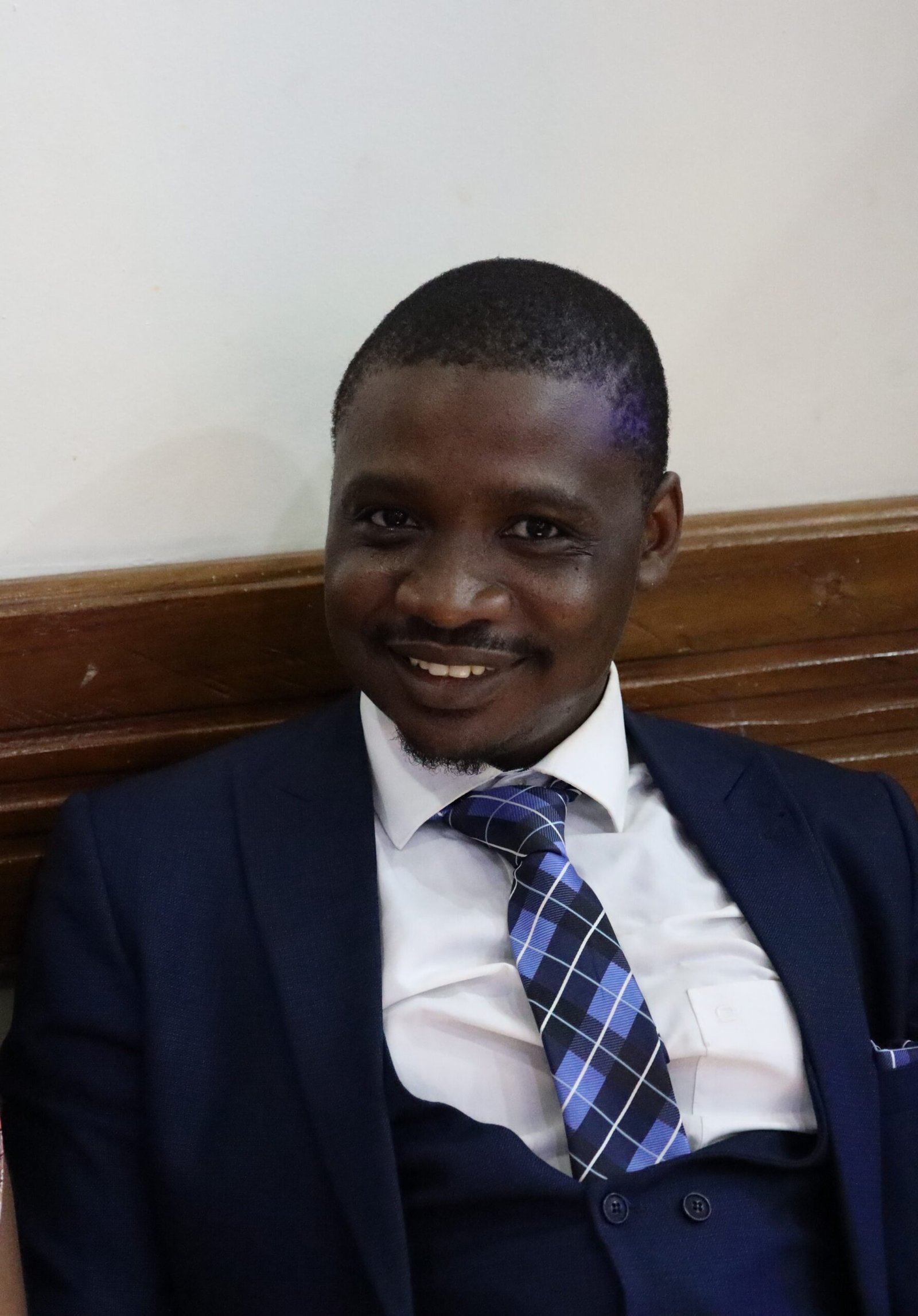
Vic’Adex is the literary and cultural identity of Adetimilehin Inioluwa Victor, a Nigerian author and strategist whose work across poetry, essays, performance and cultural projects explores memory, identity, faith, power, heritage and the changing conditions of African life. He is the founder of 60 Seconds Poetry and Open Mic Ogbomoso. Vic’Adex is one voice working across many forms.